

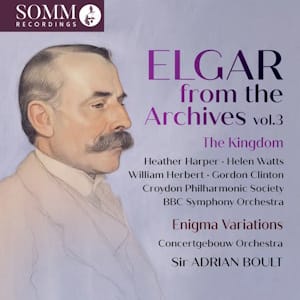
The third volume in the series Elgar from the Archives from SOMM Recordings includes two historic recordings conducted by Sir Adrian Boult: the oratorio The Kingdom, Op. 51 and the ever-popular Variations on an Original Theme ‘Enigma,’ Op. 36. These variations form an interesting comparison to the two acoustic versions from the well-received Vol 1 in this series [ARIADNE 5046], one conducted by the composer in 1920, the other by Sir Henry Wood in 1924. These recordings, released commercially for the first time, are remastered by audio engineer Lani Spahr, whose work on Elgar from the Archives Vol 1 James Jolly, Editor in Chief of Gramophone Magazine, described as “astounding,” adding that “thanks to Siva Oke’s SOMM label, Spahr has an outlet for his truly revelatory work.”
Inspired by the remarks of one of his school teachers that the Apostles were poor men, young men, perhaps “no cleverer than some of you here,” Elgar conceived the idea of a work depicting the Apostles as ordinary men reacting to extraordinary events. He envisioned a trilogy of oratorios consisting of The Apostles, Op. 49, The Kingdom, and an unrealized work, The Last Judgement. He made initial sketches for The Kingdom as early as 1882, when he was still serving as organist at St George’s Catholic Church in Worcester. Following an orchestral Prelude, which introduces the main musical themes and sets the mood of the work, the oratorio is in five parts: I. In the Upper Room; II. At the Beautiful Gate; III. Pentecost; IV. The Sign of Healing; and V. The Upper Room.
The Kingdom is written for four soloists, choir, and large orchestra—featuring, in this recording, Heather Harper, soprano (The Blessed Virgin); Helen Watts, contralto (Mary Magdalene); William Herbert, tenor (St. John); and Gordon Clinton, baritone (St. Peter), with the Croydon Philharmonic Society and BBC Symphony Orchestra conducted by Sir Adrian Boult. This programme on 29 May, 1957 at the Royal Festival Hall was part of the centenary celebrations for Elgar’s birth. Boult admired The Kingdom above all the other major choral works of Elgar, and his complete understanding of and identification with the work is shown in his expert pacing and observation of dynamics.
On 29th February, 1940, about ten weeks before Nazi forces invaded The Netherlands, Boult conducted the Amsterdam Concertgebouw Orchestra in a concert broadcast from Hilversum by the Dutch public broadcasting association. The program concluded with Elgar’s Enigma Variations, the work that helped to establish Elgar’s growing reputation internationally. In a programme note, Elgar wrote, “This work, commenced in a spirit of humour & continued in deep seriousness, contains sketches of the composer’s friends.” This Dutch performance is one of Boult’s finest interpretations of the work, and it has more than stood the test of its 86 years.
A rare live performance of Elgar’s The Kingdom at the Festival Hall alerted me to this piece’s power. That performance with the Crouch End Chorus boasted one of the finest of latter-day soloist line-ups, not least the radiant soprano Francesca Chiejina.
This live London performance predates Boult’s studio recording by over a decade.
Here’s an introduction (half an hour) by Sir Adrian Boult himself to both The Apostles and The KIngdom:
This is an all-Boult disc, but twi different orchestras. For The Kingdom it is teh BBC Symphony Orchestra (then surely in its heyday) with the Croydon Phlharmonic Society as chorus, But look at the two female soloists: Heather Harper (soprano) as The Blessed Virgin, and Helen Watts (contralto) as Mary Magdalene. William Herbert, tenor, sangSt John, and Gordon Clinton, baritone, sang St Peter.
Set in Jerusalem, we begin in “The Upper Room”. Boult shapes the orchestral Prelude so beautifully, pure Elgar, so stylish, before the chorus and St Peter enter (“Seek first the Kingdom of God, / and his Righteousness”):
Willian Herbert’s voice is positively haunting at “Surely, they are my people”. But it is the chorus that is so impressive, so clear in this May 1957 recording. Try the combined vocal forces (“All”) at “Let them give thanks,” about half way through this excerpt:
There is such detail here: the lower brass imitating the chorus at “Let his habitation be desolate,” a testament to Lani Spahr’s restoration.There is structural thought, too – the final chorus of this part, :O ye priests!” is electric in Boult’s hands.
As part of this part, Elgar uses the Gregorian chant O sacrum convivium (O sacred feast): see the YouTube below or hear it with scrolling neumes at Neumz.
The time shifts to the Morn of Pentecost; and we are “At the Beautiful Gate”. Female voices predominate two fo the Marys (Mary and Mary Magdalene) hear a service at the temple. A lame man is carried to teh gate, and they are reminded of Jesus’ compassion. Heather Harper is absolutely radiant (“The singers are before the altar”); Helen Watts joins her in (pardon the pun) heavenly counterpoint:
The third section is Pentecost (In the Upper Room). William Herbert is superb at “And when the day of Pentecost was fully come …” but it is also how Boult ensures teh music is shot through with a sort of mystic light that is so impressive. And how bold the choitr’s “He who walketh upon the wings of his wind”:
The live provenance seems to bring in extra electricity from Boult, for sure, which means that when the music relaxes, the effect is even greater.
The second part of Part III, “In Solomon’s Porch” features Gordon Clinton in sterling, powerful voice as St Peter. Together with Boult’s grasp of the score, his alignment with Elgar’s compositional voice, and the added frisson of live performance, this adds up to supreme Elgar:
How radiant is Helen Watts’ “Daughters of Jerusalem” (around 9 minutes into track 5): “Daughters of Jerusalem, / weep not for me,/ but weep for yourselves, / and for your children”. It is all part of the preparation, structurally, for Peter’s “Repent, – / and be baptised every one of you, / in the Name of Jesus Christ” . And how beautifully Clinton shapes this last phrase, the choir offering the crowning climax.
Helen Watts it is who opens the fourth section, “The Sign of Healing” (At The Beautiful Gate)” in fabulous voice; as is Clinton, at “Ye men of Israel”; William Herbert rises to John’s riposte, moving effortlessly from strength to sweetness of tone:
That excitement mentioned earlier comes into its own at he visceral nature of “The Arrest” (teh second section of the fourth part). Here, Mary Magdalene’s recitative cedes to Mary’s “The sun goeth down,” which finds the young Heather Harper in radiant voice. This is stunning singing of the first order, with the recording completely supporting Harper’s beauty of voice and sincerity of intent
Finally, “The Upper Room (In Fellowship),” The Kingdom‘s fifth part. It begins with an orchestral out-breath and a passage of maximum choral majesty (“The voice of joy / is in the dwelling of the righteous”. The sheer frisson of the choral contributions is extraordinary. There is a religious fervour here that borders on ecstasy;
The piece culminates with a setting of the Lord’s Prayer (“Thy Kingdom come” taking us home to the work’s title)
I thought I’d tackle The Kingdom before SOMM’s release of The Apostles because of the coupling, the “Enigma” Variations, in the light of the recent Proms performance by the Berliner Philarmoniker and Petrenko (see this post for my review). This one is 29 February 1940, from the Concertgebouw, Amsterdam
This is a fluid version, as one can hear from Variation I,”C. A. E.”; listen to how, despite this, Boult gives the music space to breathe:
There is terrific character here. there are actually real parallels with Petrenko. The punchiness of IV, “W.M.B.” pitted against the wonderful “stretch” of the opening, like an awakening into the woodwind deftness in Variation V, “R.P.A.”:
Again I have to make parallels to Petrenko’s performance in the visceral nature of “Troyte”:
Key to Boult’s performance here is the dynamic/lyric juxtapositions, which he seems to regularly emphasise. “Nimrod” is of course the still cetre, and Boult’s tempo is perfect: a real blossoming without recourse to Bernstein-like stasis (although there’s a place for that, too, surely?). A lovely sense of theopening of a flower in Boult – and unashamed portamento, too:
The inter-movement contrasts of Boult seem to operate on different levels here: contrats his Numrod to the very next variation, “Dorabella,” and also teh contrasts within, the strings against woodwind and teh changes of articulation therein:
I also love the doggy fun of “G.R.S.” and, later, how Boult gathers momentum for the finale’s outbursts, holding the orchestra under a tight rein. This is not the neatest of finales, but in terms of excitement does hit the spot:
The “Enigma” is interesting, certainly, but it is The Kingdom that makes this a vital acquisition. The twofer is available from Amazon here.


%20Graham%20Boulton.jpeg?w=160&resize=160,160&ssl=1 "Celebrating John Joubert at Royal Birmingham Conservatoire in advance of his 2027 centenary")