


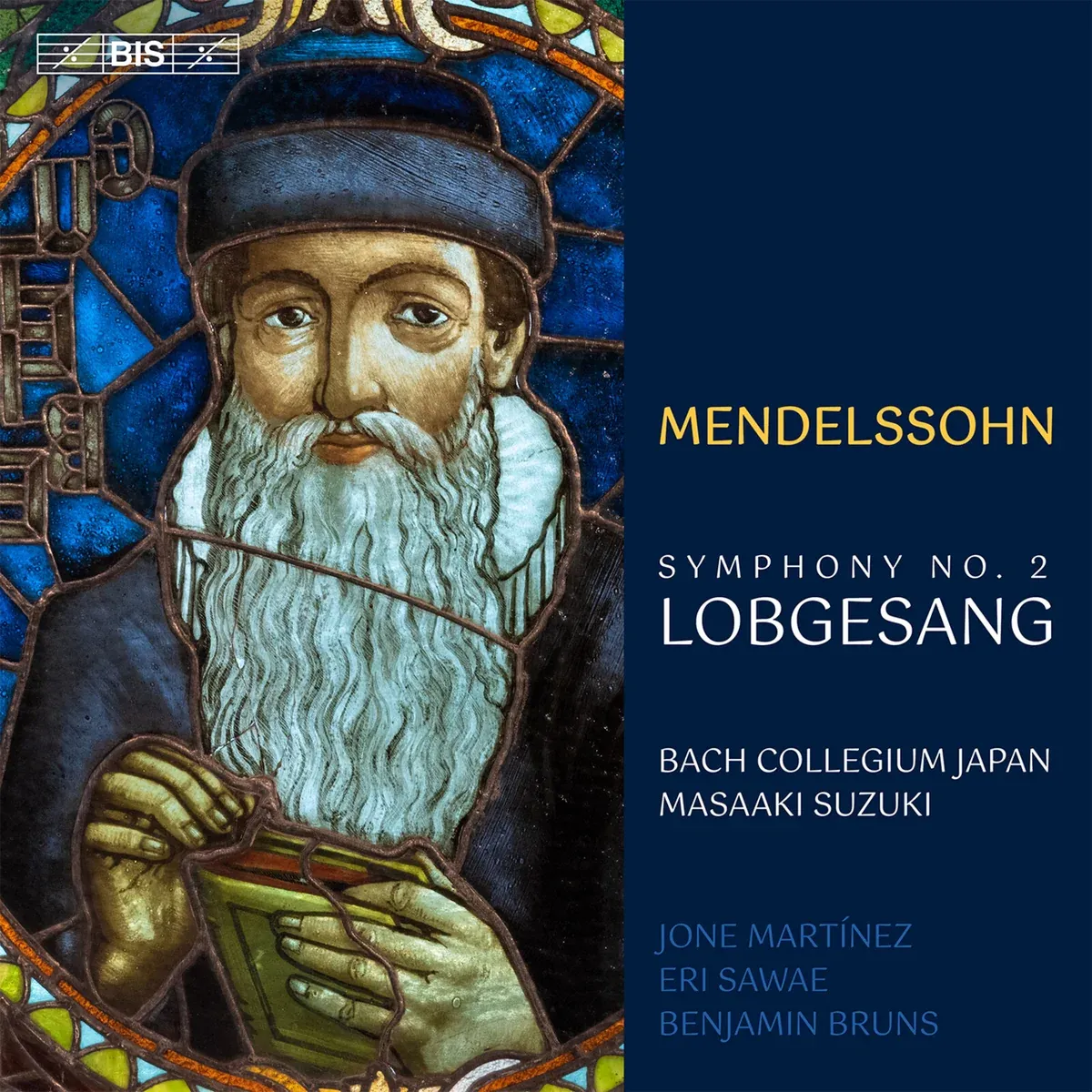
It is Mendelssohn’s Third and Fourth Symphonies that get all the attention. Yes, there is power in nicknames (Scottish and Italian respectively), but the fifth has one too and I can count performances I’ve heard live of that on one hand (“Reformation”). So does No. 2 – Lobgesang – Hymn of Praise, and I don’t think I’ve ever heard this one live.
Composed in 1839-40, to mark the 400th anniversary of Gutenberg’s invention of the printing press with movable type. Festivities (!) lasted for several days, including a staging of an opera by Lortzing called Hans Sachs (some might remember this post on Lortzing’s Der Waffenschmied). The “Lobgesang” symphony was first performed in the Thomaskirche in Leipzig.
Probably too many “grand” performances have done it no favours. But Masaaki Suzukii, best known for his Bach, is on a mission – his opening to the 24-minute “Sinfonia” is brisk. he takes the “con moto” of the “Maestoso vcon moto” seriously, and the music emerges as if newly-minted, leading to a crowning trombone chorale climax (“Alles was Oden hat”):
Suzuki’s scherzo – Allegretto un poco agitato – is the perfect reflection of the indicator. Again, the music moves, and how superb is BIS’ recording; the “finale” of teh third part even in its indication takes us churchwards: Adagio religioso. The woodwind sing beautifully, and reverently:
This tripartite structure forms the Symphony’s “Part I”. The choral entrance at he word “Alles” sets the tone for the nine-movement cantata that is Part II: Alles was Odem hat, lobet dem Herrn” (Let everything that has breath, praise the Lord). Soprano Jone Martinez is radiant here; Benjamin Bruns is the eloquent tenor soloist in “Er zählet undere Tränen”; he is inspiring in his cries of “Wachet aif!” in his aria, “Stricke des Todes … Wir riefen in der Finsternis”:
Note how by keeping the textures light, Suzuki gives the music a real transparency, especially in the choruses:
If you’re looking for Bach counterpoint filtered through Mendelssohn’s lens, look no further than “Die Nacht ist vergangen”:
It is a chorale that acts as an emotional turning point from darkness (“Finsternis”) to light, so beautifully sung here. Mendelssohn adds woodwind lines so perfectly (and so perfectly in his own “voice”):
The booklet notes (Horst A. Scholz) are right to indicate a shadow of darkness in the bass for the duet (soprano. tenor), “Drum sing ich mit meinem Liede”:
ailable from Amazon here.
Suzuki shapes the performance magnificently so that he light does indeed shine through. A terrific release.
Available from Amazon here. Streaming below

%20(c)%20Chris%20Christodoulou.jpg?w=670&resize=670,446&ssl=1 "Not quite the sum of its parts: starry casting with Carmen Giannattasio, Saimir Pirgu & Bryn Terfel fails to lift Oxford International Opera's debut with Puccini's Tosca")