


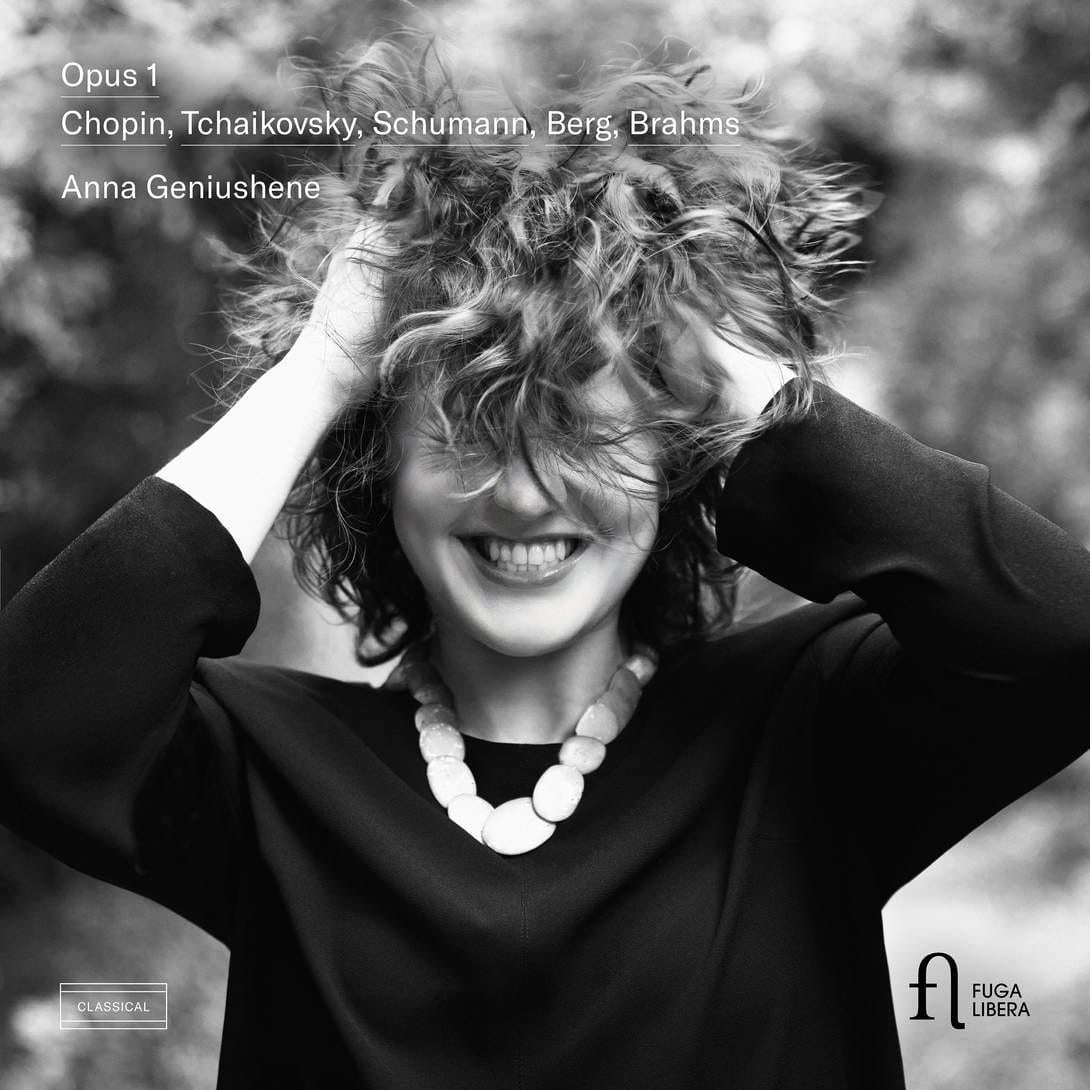
A fine idea, really well realised by Anna Geniushene on the Fuga Libera label. Following on from an album of lullabies, this focuses on the first-published works of major composers, “an exploration of first steps” as the pianist puts it (she pens both booklet introduction and full notes).
Intention varies for an Opus 1 – a statement of intent, or the first piece worthy of birth to a wide public? Whatever the case across this disc, the music always serves not only to illuminate what was to come, but also stands in its own right.
Here’s the promo video:
We begin with Chopin’s Op. 1, Rondo in C-Minor of 1825, given a performance of magnificent textural and harmonic awareness by Geniushene. It is amazing to think this we s composed when Chopin was just 15 – many of his hallmarks are there, from decoration (crisply delivered here) to flowing harmonic sequences. Geniushene highlights the contrasts inherent in the piece, and integrates the pure octave passages well
Tchaikovsky’s Op. 1 was Two Pieces of 1886, a “Scherzo à la russe,” and an Impromptu, written while the composer was a young professor a the Moscow Conservatoire. The Scherzo, folkish, its chords beautifully judged here, leads to the more extrovert Imprmptu, is more outward-facing (it is marked Allegro furioso; it does include a complete contrast of massive interiority, though (which might be why the performer refers to it as “more lyrical and introspective”: not the initial impression, certainly. Here they are:
Great to see Schumann’s Abegg Variations here, composed at the age of 18. Geniushene melts the piece into existence – it is again astonishing how much of the mature composer’s signature is here. Impressive, too, how Geniushene makes the filigree sound entirely of Schumann. This is mightily impressive Schumann playing:
Interestingly, there is a video from the Busoni Competition of Geniushene playing late Schumann: the Drei Fantasiestücke, Op. 111 of 1851, which nicely bookends the composer’s output and which also reminds us of the still-unappreciated stature of late Schumann:
Alban Berg’s Op. 1 dates from 1907/08 and sits “around” B-Minor – cadences n this key articulate the major sections. There is even an exposition repeat. Berg was not quite a rookie composer when he wrote this – it is prefaced by a plethora of early songs (including the orchestrated Sieben frühe Lieder) and a set of variations for piano (Zwölf Variationen über ein eigenes Thema in C, 1908).
This is quite a daring performance in that Geniushene allows herself to :love” some of the choral progressions almost to death – the music does come close to losing momentum, and directionality is vital in this piece (although there is B-Minor here, at the beginning and end of sections and at the central climax, much of that sense of forward movement is effected by voice-leading processes).
Brahms offers a far more muscular beginning in his Piano Sonata in C, Op. 1 of 1853 (actually his second, but his is one of those instances of reverse publishing order). That opening is sometimes compared to Beethoven’s “Hammerklavier” Sonata, and again Geniushene takes us from that to moments of real interiority. There is darkness in her performance, but also a clarity of texture that is most laudable, especially in the most thicket-like passages:
The second movement is a set of variations, “Andante (nach einem altdeutschen Minneliede) – based on a German song that Brahms included in his Deutsche Volkslieder, Verstohlen geht der Mond auf:
Geniushere captures the essence of Brahms beautifully, demonstrated in microcosm in the shifting moods across the Scherzo. The finale, an “Allegro con fuoco,” fizzes with energy. It also demonstrates the fine recording here (Teldex-Studio, Berlin, 2024). Chords tend towards the monumental, against internal disquiet:
A fine disc – I’d love to hear Geniushene live. There is no biographical information in the booklet, interestingly: she was Silver Medallist in the 2022 Cliburn Competition. Born Moscow on New Year’s Day, 1991, Geniushene debuted in the Berlin Philharmonie’s small hall at age seven. Graduating from the Moscow Conservatoire in 2015, she forms a duo with Lukas Geniušas (see this post) and went on to the Royal Academy of Music in London.
Anna Geniushene featured also on an Alpha disc, Hallelujah Junction with Lukaš Geniušas, featuring works by Adams (the titular track), Stravinsky, Gershwin, and Copland
The disc is available from Amazon here; Hallelijah Junction here. Streaming below: