


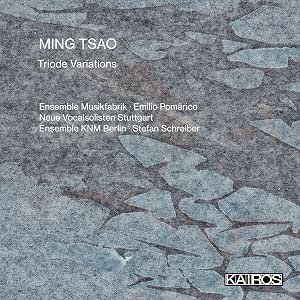
This is not the first recording of music of Ming Tsao (born 1966) for Kairos (it’s actually his third), but it’s the first one for Classical Explorer. Tsao’s instrumental background is playing violin, viola, and Chinese zither (the zheng, I assume), and as a composer he has worked with Brian Ferneyhough and, in the electronic field, Mario Davidovsky,
The idea of applying biological ideas to music is widespread, from the idea of a germ or foundational motif through to Schenker’s multi-layered and organicist analytical approach. Tsao takes a biological idea, that of “reverse transcription” (genetic mapping in which DNA becomes RNA and then back again) and applies it in his music:. In moving back to RNA, “noise” can intervene – viruses, for example – and this is manifested in Tsao’s music by “noise” in the transcription process.
The original becomes closer to a palimpsest, therefore – multiple palimpsests, in fact. There is an objectivist slant, too:
The goal is to decouple expression from intention and a psychology of interpretation. The materials are in themselves expressive and not vehicles for an expressive ‘voice’.
Tsao destabilises his original so much that we are often clueless as to the generating musics:
My compositions are palimpsests where many forms of musical expression have traces and contribute to the work’s aura as something that lies outside of a single composing mind
The “source” for Triodes is Schoenberg’s Variations for Orchestra, Op. 31:
Meter, rhythm, and tempo are all modified. Tsao uses an electrical metaphor:
Sudden changes in voltage are applied to small fragments (one or two measures) of Schoenberg’s original so that electrical flow, resistance, and interference appear at every level of the variational structure. The electrical circuit of a triode keeps Schoenberg’s music occasionally recognisable but also redirects and connecxts it to wider contexts that are quite remote.
Triode Variations (2019-2020) comprises three movements, two interludes, and a postlude, The music is disjunct, for sure, but there is such excellence and confidence in Ensemble Musikfabrik’s performance that it all sounds, if not perfectly natural, certainly all utterly convincing. There s also yet another layer to this: the poem Triodes, by J. H. Prynne (you can see some of it here). The first couplet seems particularly relevant:
Pandora wrote down her next sight
of the ossuary in cryptic notation
The number of syllables in a line determines the “bar numerator” (number of beats in a bar), accents, emphases and pauses, while the denominator (what type of beats they are – quavers, crotchets, etc) is randomly assigned. The documentation also includes a reproduction of the “circuit diagram” for a triode, incidentally.
Emilio Pomárico, a name new to me, directs. The music is a fertile field – by which I mean, its worth persevering with if it feels a challenge at first. Repeated listening reveals myriad colours and, despite the composer’s description, real expressivity (a bit like there is expressivity in Stravinsky’s determinedly “objectivist” Neo-Classicism).
Here’s the opening (if you use this link, it takes you to the YouTube for the whole piece):
Next, Das wassergewordene Kanonbuch (The “water-turned” book of canons), a piece that “reverse-transcribes a puzzle canon (Rätselkanon) from the Medieval and Renaissance periods while also referencing the poetry os Paul Celan. Ciphers here require solutions, except for the Celan movements, which the composer refers to as mire like a “letter in a bottle” – a reference to a metaphor used by Celan himself in a speech he gave when receiving the Literature Prize of the Free Hanseatic City of Bremen in 1958. And again, Prynne’s poetry is used to determine rhythms and metrics, this time the 1999 poem Pearls That Were (which itself references Shakespeare’s “Full Fathom Five” from The Tempest). One can see how the Shakespeare maps on to Tsao’s core aesthetic of transformation:
But doth offer a sea change / Into something rich and strange
Texts are included, as well as the original references. The first, for example, “Noli me legere” works with the “Kyrie” from Josquin Desprez’s Missa L’homme armé super voces musicales:
One can hear the background more here, I suggest, “Reverte citius,” also based on Josquin’s Missa l’homme armé, but which surely also seems to reference the Allegri Miserere, at least in spirit:
There are 20 canons, so one more example from one of my personal favourite composers, Johannes Ockeghem: the Kyrie from the Missa Prolationiom (play Tsao’s “Die Zahlen” from the streaming platforms below afterwards):
… and so it continues: Dufay , Johannes Ciconia, Cordier, Palestrina, Antoine Brumel, Willaert, Lassus, and finally, Machaut. The transformations are fascinating. The final one is “Finis est principium” from Machaut’s rondeau, Ma fin est mon commencement, a crab canon over a palindrome:
The way I experience these re-imaginings is that the older musics are heard as if whispers in a Modernist wind. There are many extended vocal techniques here, and the Neue Vokalsolisten Stuttgart is a faultless ensemble. No conductor is given, which is true makes this achievement even more astonishing.
Finally, Refuse Collection (2017), performed by the Ensemble KNM Berlin, conducted by Stefan Schreiber. More Schoenberg, now a piece I know and don’t-quite-love, set in the analysis class of my undergrad years: the Begleitungsmusik zu einer Lichtspielszene (usually translated as “Accompaniment to a Cinematographical Scene”). Again, the distorting methodology is a metric grid, now on the 2004 poem Refuse Collection (2004) by J. H. Prynne. “Refuse” is used also in teh sense of to “re-fuse,” to put back together.
I like the composer’s description of the frictions between the inspirations:
Under the pressure of the poem, my musical composition works against Schoenberg’s original music by injecting a virus that disrupts the music’s communicative and lyrical point of view. In biology, the virus integrates with the host cell’s genomes, replicating along with it but remaining dormant until the right sort of conditions emerge for it to reactivate in my reverse-transcription.
So. the virus’ intervention is depicted in music via “rhythmic and metric violence” towards the original, via Prynne’s poetic text. The booklet quotes the poem (which I for one experience as James Joyce-like) and illustrates how syllable counts create “resulting musical meters”. The composer injects bars of his own for “temporal reasons”. Again, chance informs one half of the time signatures. Basically, the poem interrupts the mapping of the Schoenberg in unpredictable ways.
Here’s the Schoenberg – and it’s true that snippets do surface from time to time in Tsao’s piece. This is Boulez, who seems the only real choice in this context, with the BBC Symphony Orchestra. Incidentally, the YouTube title is mis-spelled:
A superb release, available from Amazon here. Previous releases of Ming Tsao’s music on Kairos are Die Geisterinsel (Staatsoper Stuttgart: Amazon) and Plus Minus (Ensemble Ascolta: Amazon).
You can find the full score here.


%20Graham%20Boulton.jpeg?w=160&resize=160,160&ssl=1 "Celebrating John Joubert at Royal Birmingham Conservatoire in advance of his 2027 centenary")