
Feldman & Beckett: Words & Music
Sheffield Chamber Music Festival, covered several times over the years by Classical Explorer, seems to exude a ferocious curiosity that spills over into the most remarkable concert programming. The afternoon of Monday, 18 May found a round table at the Showroom Cinema on Exploring Cocteau’s “The Human Voice” (with soprano, Claire Booth, Dr James Jackson, Dr Caroline Potter, and Dr Ana Maria Sanchez-Arce), which included a screening of Pedro Almodovar’s film La voz humana (which can be seen in full here), ahead of the performance on Tuesday evening of Poulenc’s La Voix humaine (which, sadly, I was unable to attend).
Film has, of course, played a vital part of the Sheffield experience previously: immediately, Battleship Potemkin springs to mind, as well as Saint-Saëns’ music to the film L’assassinat du duc de Guise.
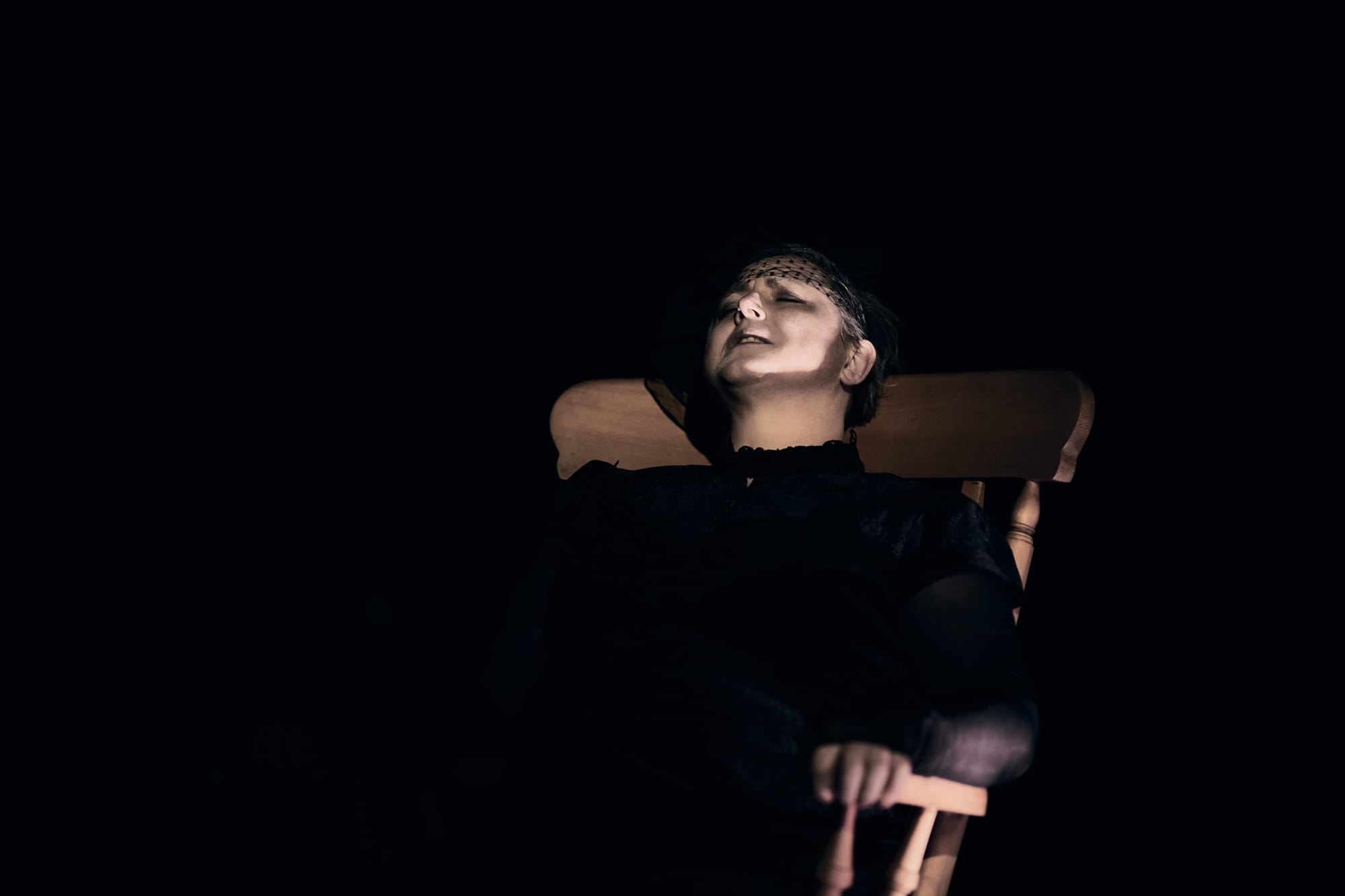
The evening concert still held pure magic: Feldman & Beckett: Words & Music, starting with Samuel Beckett’s Rockaby, Siobhán McSweeney in the chair, (literally) revolving, present even as we entered the round.
Daniel Labeille explains at the beginning of the YouTube performance below how the piece came about: planning a festival to mark Beckett’s 75th birthday, Labeille wrote to Beckett asking for a piece specifically for that event. A couple of months later, Rockaby arrived from Paris, with a note:
For your project, if you think it worthwhile.
The play premiered on April 8, 1981 at the State University of New York at Buffalo, starring Billie Whitelaw (1932 – 2014), directed by Alan Schneider (1917 – 1984) and produced by Daniel Labeille. Here’s Labeille film, with Billie Whitelaw as the protagonist:
… and here’s an alternative, with Penelope Wilton.
A woman (“W”) sits on a rocking chair, rotating (see this post’s header photo). A pre-recorded narration is for the most part what we hear (“V”). This extended lullaby is a “drive towards death,” in Beckett’s words.
Time she stopped
… is a vital part of the play, and by extension, of this whole first half. The way McSweeney echoed the recorded narration was extraordinary: was she dreaming, or hallucinating? But those echoes brought out the musical aspect of Beckett’s play: effectively musical imitation. And, like the close of the “Scene du champs” from Berlioz’s Symphonie fantastique, where there is no more imitation from a distance (although the ear tends to hear it!). at the close of the play there is just the one voice.
Silence, too, was a vital part, crackling with emotion, uninterrupted by the perfectly, extraordinarily quiet audience. And silence carries meaning both in Beckett and Feldman’s orbit (in the latter’s case, both absence of sound or near-silence in the quietude of execution) – as it did, of course, with John Cage.
McSweeney’s fragile and yet emotionally strong, almost desperate cries of “more” following those silences shot through to the heart: this was an extraordinary performance, born of the most minimal of means.
After Beckett, Feldman, before the two conjoined in the second half. Feldman’s Why Patterns? (1978). There is a score, but it is “uncoordinated” (something found a lot in Feldman’s early music), so while the music starts together, the (here, three: flute/alto flute, percussion and piano) musicians take individual paths, only to meet again at the end. You can see the whole score at Universal Edition’s website here.
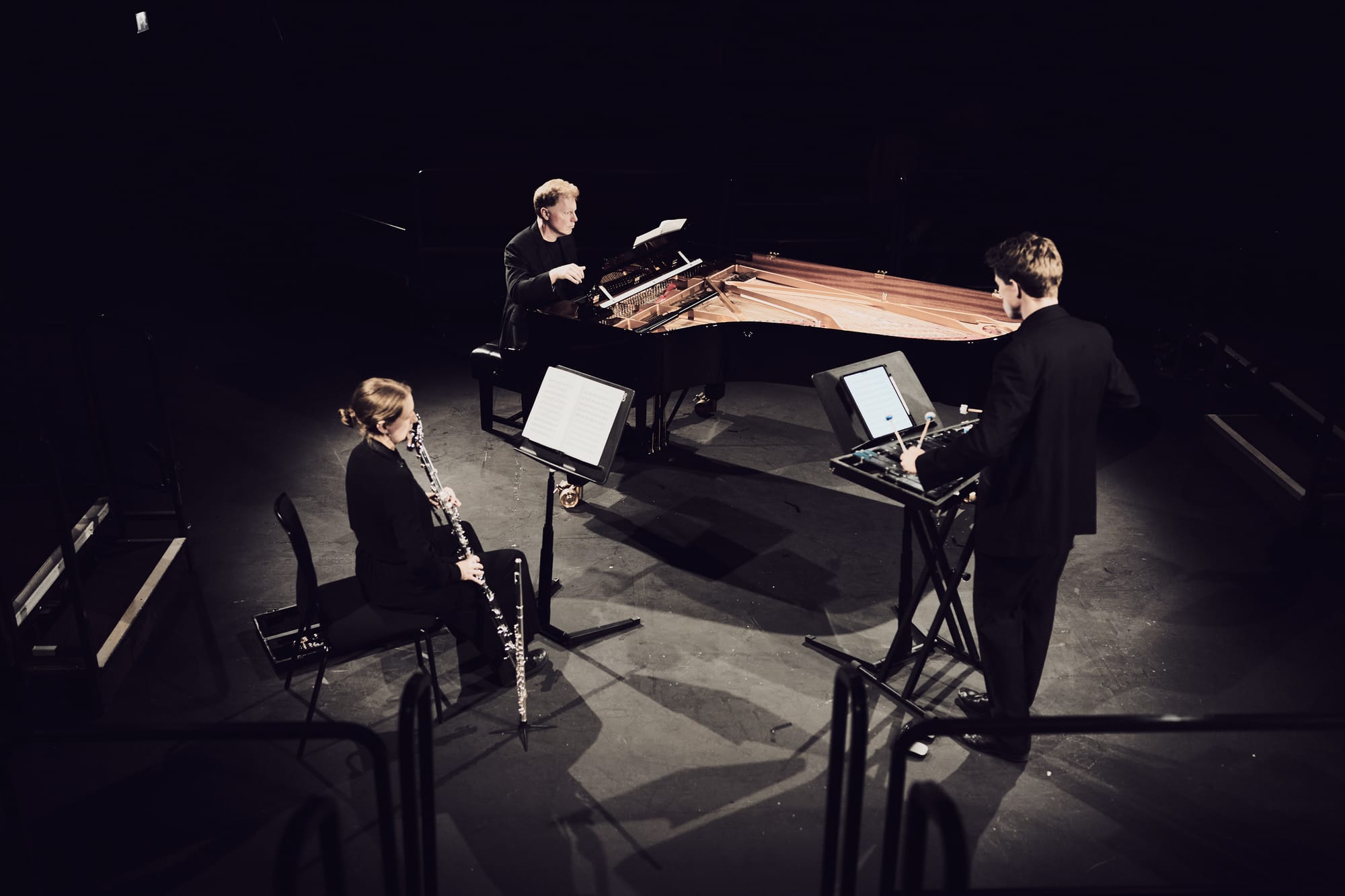
The silvery, slow repetitions (Claire Jeffries, flute; Lewis Lee, glockenspiel, Tim Horton, piano), like Beckett’s Rockaby, more than contradicted rhythm and time: they negated them, offering a supra-temporal space of contemplation. The flute offers a sustaining aspect against the strikes of percussion, later offering up an eloquent soliloquy in lonely melody. The ear inevitably makes correspondences – as humans, we search for meaning even where there is none – different, I am sure, for each of us. Again, that silent audience, allowing Feldman’s music to resonate at the very deepest level.
And again like Beckett, repetition is key: not Minimalism, but music of minimalist means. That creates very specific demands on the players: concentration cannot falter for a millisecond, and it did not. This is extraordinary music, by Feldman’s standards quite short (around half an hour). Here’s a performance with score by the California EAR Unit:
Words & Music is for two speakers and chamber ensemble (flute/piccolo, flute, vibraphone, piano, violin, viola, and cello). Words are represented by Joe (McSweeney), music by the conductor, George Morton, and his players (with T-shirts telling us so). There is a third “character,” the tyrannical Croak (Jonjo O’Neill), clad in regal furs and pyjamas, immediately bringing Maxwell Davies and his Mad King into the frame of reference. Croak commands various aspects are explored by the others (love, ageing and so on).
It was Beckett and Feldman’s previous experience of collaboration, the opera Neither, that led Beckett to Feldman for Words & Music. Feldman’s comments are prescient:
I never liked anyone else’s approach to Beckett. I felt it was a little too easy; they were treating him as if he were an existentialist hero, rather than a tragic hero. And he’s a word man, a fantastic word man. And I always felt that I was a note man. I think that’s what brought me to him. A kind of shared longing: this saturated, unending longing that he has, and that I have.
(from Frost E. C., ‘The Note Man and the Word Man: An Interview with Morton Feldman about Composing the Music for Samuel Beckett’s Radio Play, Words and Music Archived 25 February 2007 at the Wayback Machine’ in Bryden, M., (Ed.) Samuel Beckett and Music (New York: Oxford University Press, 1998), p 51)
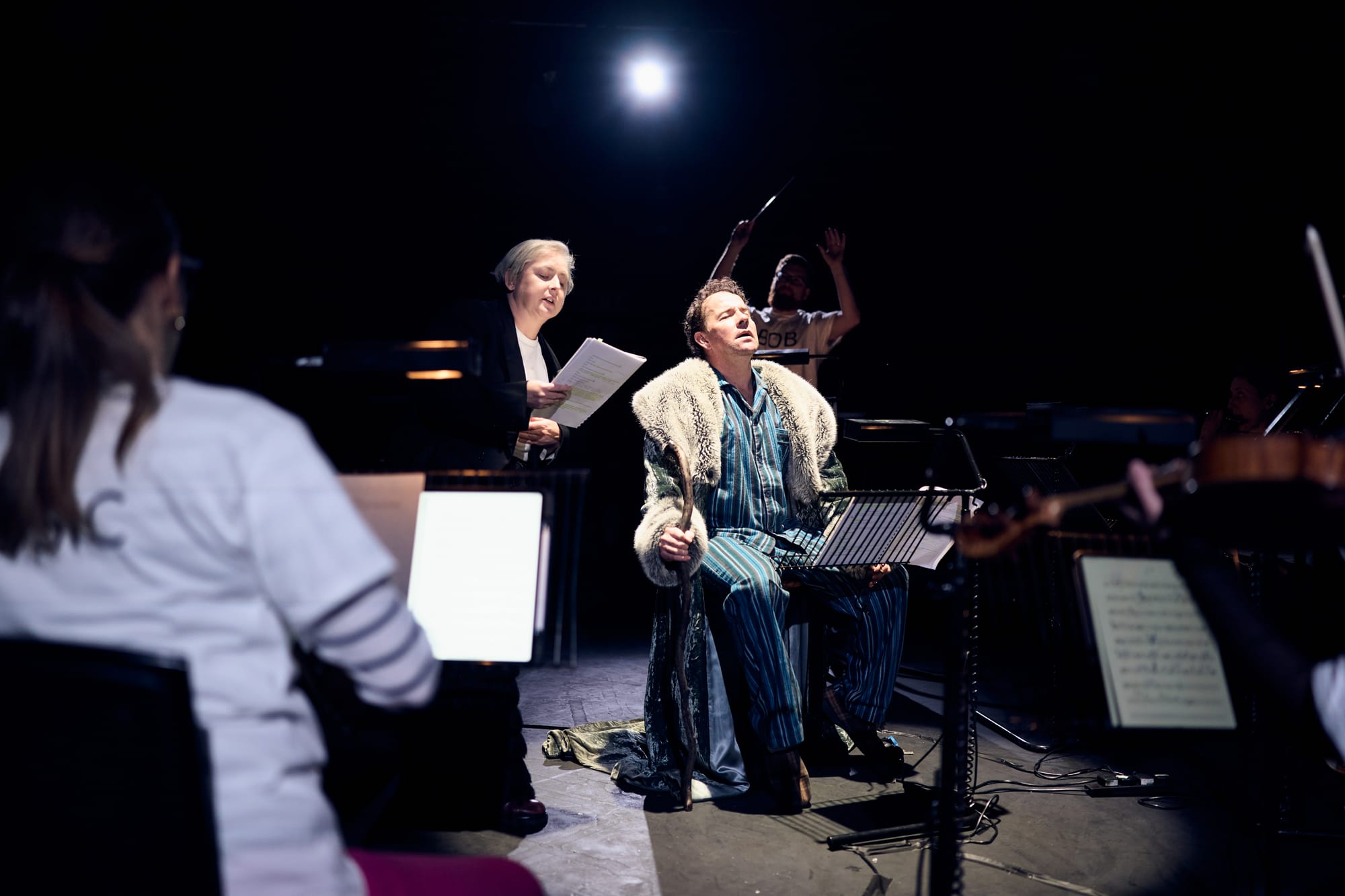
This is Beckett (and Feldman) in distinctly lighter mood: Absurdist comedy, perhaps, Croak most definitely a caricature, Against this is a dissection and lambasting of the act of performance itself (tuning is part of the “event”). The musicians gave it their all, including wonderful facial expressions and gestures. Feldman takes music’s bare bones and gives them huge meaning. The clue to that meaning is surely in the quote above: a “saturated, unending longing” that counterpointed the slapstick.
Like all of the pieces on the programme, performances surely could not be bettered. And while this programming might have been bread and butter in 1980s London, now down South some of us hanker for the merest crumb. Sheffield is a lucky place indeed. For all of the freshness of the next afternoon’s concert of Beethoven (review to follow), it is the concert Words & Music that made an unforgettable impression.
All photos © Matthew Johnson