


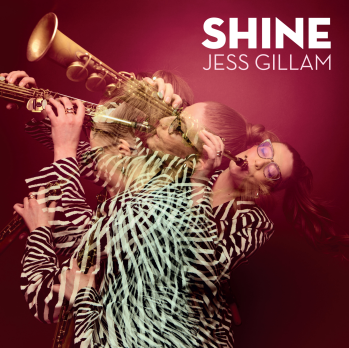
This album has achieved notable success already(released October 9, and achieving top spot in the UK Classical Chart)
Helen Rogers, Executive Producer at Decca Classics, says:
To see Jess achieve three consecutive No. 1 albums with SHINE is remarkable. Jess has a unique gift and this album captures her exceptional musicianship, creativity, and infectious energy at its finest. Ten years on from her breakthrough at BBC Young Musician, we are incredibly proud to be working alongside her. She is an unstoppable force.
We begin with Shine You No More by Rune Tonsgaard Sørensen, which fnds Gillam with the Danish String Quartet. The arrangement, by Simon Parkin, is excellent; it begins with gillam, alone, offering roulade after roulade. This is an original composition but it has the feel of something traditional – a Danish/Scottish reel, perhaps. For all of the velocity and vim of the track’s main body,I do love the slow, haunting sax section, though. Here’s a video:
Nice to see some Kate Bush here – Jig of Life, heard here by the artist herself. It’s from the album Hounds of Love:
After the hectic Shine You No More, a jig sounds just the follow-on, and Gillam adher band transfer all of Bush’s primal energy (the music has its origins in a Greek/Bulgaria firewalking dance). The arranger, Alistair Vennert, also plays viola on here:
Back in time to Barbara Strozzi, now (1619-77) and one of her most famous pieces, Che si può fare? from her 1657 Ariette a voce sola, Op. 6. Here’s a lovely performance of the original by soprano Cynthia Sánchez and theorbist César Castellanos – a most atmospheric video, too, but listen to the performance, so pure:
The melody sits perfectly on Gillam’s soulful sax This is teh recognition of sadness and despair that contextualises the album’s surrounding glee.
Here’s a live performance to complement that on the disc, from Hamburg’s Elbphilharmonie:
This is continued by the quiet interiorised emotion of O’Cathalin’s Taghair oom oo Lámh (Give me your hand) – curiously discussed out of playing order in teh booklet. Gillam tells the story of the recording of this track – of a late night session and just one more take despite numb lips and tiredness – and that’s what we hear here. It’s a lovely, intimate number heard in an arrangement by double-bassist on this recording Sam Becker:
After Mahan Esfahani and Helsinki Baroque Orchestra’s superb C. P. E. Bach concert last week (ADD LINK WHEN PUBLISHED), it feels right to have some of that composer’s music here: an “Allegro assai”. The description in the booklet isn’t really helpful if you want to go and explore more, a problem perhaps of the contemporary excerpt culture. The notes describe this as “originally for flute, cello or harpsichord” but give us nothing else. To complicate matters, once one finds the concerto (A-Minor, Wq 166 in the flute version), So there are indeed three versions: Wq 166/H 431 is flute and orchestra, Wq 170/H 432 is the cello version, while the original is for keyboard and orchestra (Wq 28/H 130). All versions date from 1750.
Here’s a performance of the complete piece:
Traverso: Felipe Egaña Violin: Leila Schayegh, Tomoe Badiarova, Meelis Orgse, Anna Dmitrieva, Franciska Hajdu, Valeria Caponnetto, Pierfrancesco Pelà Viola: Alice Vaz, Luis Pinzón Bassoon: Martin Jaser Basso Continuo: Nadine Remmert, Hugo de Rodas, Néstor Fabián Cortés Garzón, Felix Görg Fantasia: 0:00 I. Allegro assai: 2:40 II. Andante: 12:41 III. Allegro assai: 21:51
Gillam’s band sounds way to cushioned in this recording – there is little of the C.P.E. Bach rawness we heard so viscerally at Wigmore Hall the other day. It really only gets interesting when Gillam enters, the haunting sax sound raising an eyebrow, her phrasing drawing the listener in. The arrangement is by Simon Parkin: Yes, Gillam’s imagination is most impressive, including some bending of notes, but we are a long way away from C. P. E. – and I would suggest away from his core spirit, too:
We do stick with a sax original for the next track, though. The great Sidney Bechet. My first introduction to Bechet was actually Bechet in duet with clarinettist Claude Luter, recorded in Paris, 1949, Sobbin’ and Cryin’:
… here he is in the 1952 Petite fleur. Gillam is absolutely right in her notes that Bechet’s sound is “one of the most distinctive ever” (just listen to that vibrato – apparently inspired by Bechet’s love of Italian tenors!):
… and then there’s the vocal version with Henri Salvador, an absolute gem:
… and here Gillam is perfectly at home, creating a moment of intimacy on tsh album that is perfect.
Quite right, then, that she should continue with a Tribute to Sidney Bechet, based on this, Bechet’s version of I Found a New Baby:
Gillam’s recording is also a tribute to Barbara Thompson, who used to play this with the Medici Quartet, and is full of life:
In complete contrast, A Case of You by Joni Mitchell, from the album Blue. The original is, of course, inimitable:
Gillam describes this as “a hug in a song”.When Mitchell recorded it on Both Sides Now, the track featured saxophonist Wayne Shorter, and that inspired Gillam to her version.
Back to the good old days, when Baroque composers took a theme and ran with it – and many composers since. “La Folia” is one of the most famous themes they took, folowed by the likes of Rachmaninov/ff and even – yes – Britney Spears – the chord progression of “La Folia” is the basis of this:
Gillam’s take is beautifully laid-back, but it’s clever, too, with the solo strings creating a lovely texture into which the sax is invited:
We had Classical Explorer‘s first Britney Spears earlier in this post – here’s David Bowie (again, I think, a first) via Mick Rock’s 1973 Official Video:
I like how Gillam keeps the “special” nature of the song while escorting it into chamber music territory, in Vennart’s arrangement:
Another late-night take, the final Hildegard beings with a Prelude that leads into Gillam’s take on Hildegard’s Spiritus Sanctus vivificans vita (The Holy Spirit is living and life-giving) which is, for Gillam, an Ode to Nature. Here’s the original:
Anneliina Koskinen (from her Album ‘De Angelis).
… and here’s Gillam and friends, Prelude first:
A terrific album, carefully thought-through, beautifully realised, available from Amazon here.