


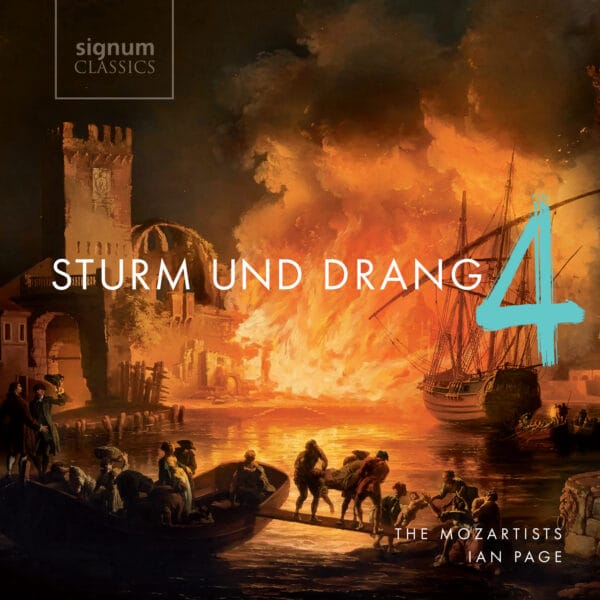
The Mozartist’s projected seven-volume series of works from the “Sturm und Drang” period (early 1760s-late 1770s) is exemplified by this disc. The fire and high emotion of the cover painting says it all, Fire on the Tiber by Claude Josef Vernet (1714-89: you can learn more about the painting here).
Goodness, what an opening to Kraus’ Symphony in C-Minor, VB 142. This is the piece Haydn predicted would be seen as a masterpiece for centuries to come but has been buried in obscurity. From the complexity and profundity of the Larghetto comes clear Sturm und Drang, music of power, punch, and contrasts with pianos that are like coiled springs.
I cannot imagine a more tender performance of the central Andante, mostly using a two-part texture. There are distinctly Haydnesque moments here (despite Krauss’ nickname of “the Swedish Mozart”). Page’s performance is not just successful because of the highlighting of contrasts and its sheer energy, but also because of its precision – this is highly disciplined playing.
There is no doubt the finale hooks straight back into the live-wire feel of the first. Page paces it perfectly, adhering to Kraus’ Allegro assai rather than finding excitement in a presto:
Symphonically, Kraus’ symphony is balanced by the final work on the disc, Haydn’s F sharp-Minor Symphony (No. 45, “Farewell”. In between come three vocal items with the ever-superb Alexandra Lowe, who we have met on no fewer than five occasions: firstly, at a Jette Parker Covent Garden extravaganza, their 20th anniversary, where Lowe was my hot pick (review), There followed a Wellgunde Götterdämmerung in London under Jurowski, a First Lady Zauberflóte at Covent Garden under Maxin Emelyanychev in 2022, the Academy of Ancient Music’s Music for an Empress, and finally, her solo recital disc Le Voyage, with Patrick Milne, piano.
It is nice to hear some Traetta, here Antigona’s aria, “Ombra cara, amorosa … Io resto sempre a piangere”. It is a lament for her deceased (murdered) brother, the aria a sort of dark siciliano, preceded by an emotionally laden recitativo accompagnato. Anexandra Lowe sings beautiflly:
Mozart next, but early Mozart, operatically: a stormy aria from La finta giardiniera sung by Aminda, who is in a fit of jealous rage at he time, and Lowe lives it. This time, Signum provides a video:
Finally, the astonnishing scne from Medea by Georg Benda and a “melodrama” (a sort of heightened recitative that included speech). The first line shows how this music is enturely in accord with the rest of the pieces on this album: “A curse be on Jason and Creusa!”. This is nearly ten minutes long and demonstrates what en effective form this was: the most famous example is Beethoven’s Fidelio act 2, perhaps, but Mozart wrote some in Zaïde and apparenlt greatly admired the idea, too:
The Haydn begins with proper indications of angst – the minor key, the piercing period oboe. The circumstances of the symphony are that the Prince for whom Haydn worked had extended his stay at the palace, meaning the musicians were separated from their loved ones for longer than anticipated. Haydn’s symphony is a respectful plea for clemency:
The slow movement is gently caressing, violins muted throughout, full of quiet dissonance and pain (the key is A-Minor):
The spirit of dance is somewhat occluded by the prevailing circumstances in the third movement, here with nicely shaped phrases from the two horns and a real sense of gesture from Page. The finale is the movement in which the instrumentalists disappear from the stage, of course, in a massive hint. The furious Presto gives way to an Adagio, both perfectly judged here, There are even sound effects invoking the elements!:
This is by no means the only recording of this wonderful symphony in the catalogues, though, so context means a lot here, and Page’s programme is perfect.
The disc is available via Amazon here.