


Øyvind Torvund Symphonic Poem No. 1, “Forest Morning” (2019, first Proms performance)
Stravinsky Violin Concerto in D major (1933)
Prokofiev Romeo and Juliet (1935/6), excerpts
The first thing to notice here is the title, taken from the Prom booklet itself: “Stravinsky and Prokofiev with the Oslo Philharmonic”. No mention whatsoever of Porsgrunn-born Norwegian composer Øyvind Torvund (born 1976), who furnished us with not only the first piece (Symphonic Poem No. 1, ‘Forest Morning’), but also the encore, Starry Night. Arranged just five days ago for the Oslo orchestra, Starry Night is fun, and light, Radio 2 soft-focus strings heard against electronic swirls and frankly, electronic boings. In a sense, the encore was the perfect encapsulation of Torvund’s characteristic juxtaposition of acoustic and electronic, it was also an ideal close: heard in a studio mix, though, the electronica makes an even greater effect (on Torvund’s The Exotica Album, performed by the Bit20 Ensemble).
(Starry Night was not the only extra piece, though: the Norwegian National Anthem was performed at the outset, introduced by BBC Radio 3 controller Sam Jackson in response to the recent death of Norway’s King Harald V at the age of 89, followed by a moment of silence.)
Torvund’s musical career began as an improvising and rock guitarist. That sense of experiment and love of electronica pervades his music, as he nestles seemingly incompatible sounds against each other. Whilst the encore pitted cartoony generated sounds against muzak, though, Torvund’s symphonic poem was altogether more Nature-inspired. Perhaps some of the birds were sometimes more mechanistic, akin to the imagined alien birds of Esa-Pekka Salonen’s Piano Concerto; others were distinctly terrestrial, fixing themselves to the honoured flute – bird trope. Torvind’s trick is to set up an atmosphere that feels cozy and familiar, and then destabilise it. Certainly glowing chords, presumably in response to the majesty of Nature Herself, cede to gestural passages, harp now equated, sonically, with pizzicato strings, themselves adjacent to aching, Romantically-inspired phrase shapes on violins (this last carrying something that recurred in the Prokofiev: a preternatural togetherness in performance).
Nordic music is itself defined by unfettered imagination, and Torvund is very much in that stream, with an added lightness of touch. Even when the destabilisations are darkly motivated, there is still the sense the composer is delighting in the process. Timbral change occurs through some kind of alchemy born of a deep understanding of the music from the conductor; the return of ‘pure’ Nature sounds later on, temporary though it was, seemed to offer a sense of hope. Perhaps the symbology is that humankind (the disruptions) should leave the forest (the almost Impressionistic passages) alone?
Here’s the Oslo Philharmonic’s recording of this piece form their disc, A Walk into the Future – on that occasion, they were conducted by Otari Elts:
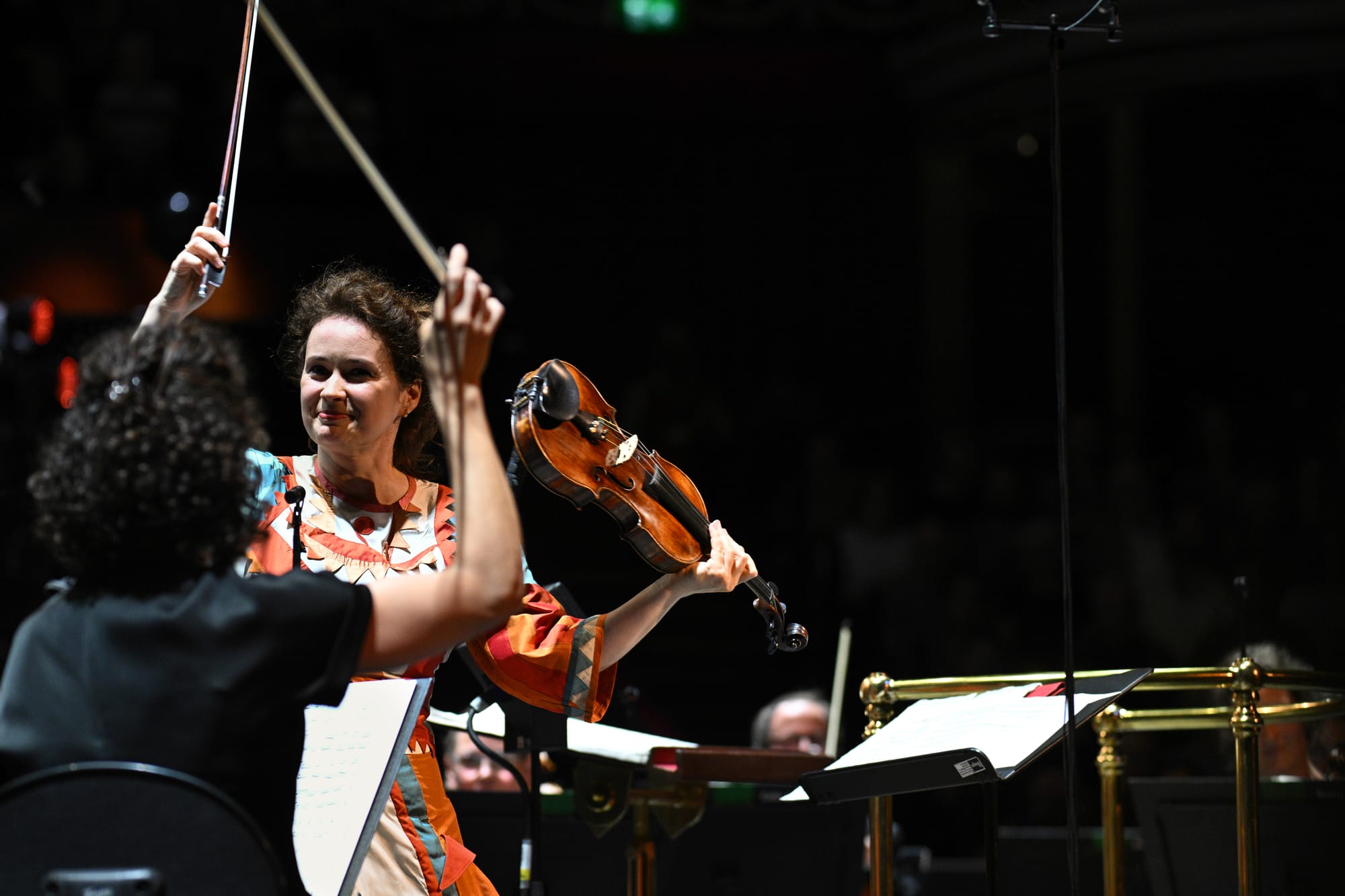
Patricia Kopatchinskaja is a regular and much-loved visitor to the Proms. I don’t often comment on soloists’ attire, but in thai case there is justification: she had a costume designed by Olga Gerber in Bern, based on one of Mikhail Larionov’s costumes for the Ballet Russes – the one she wore was the one used for the Fool’s Wife in Prokofiev’s ballet Chout, and it felt just right.
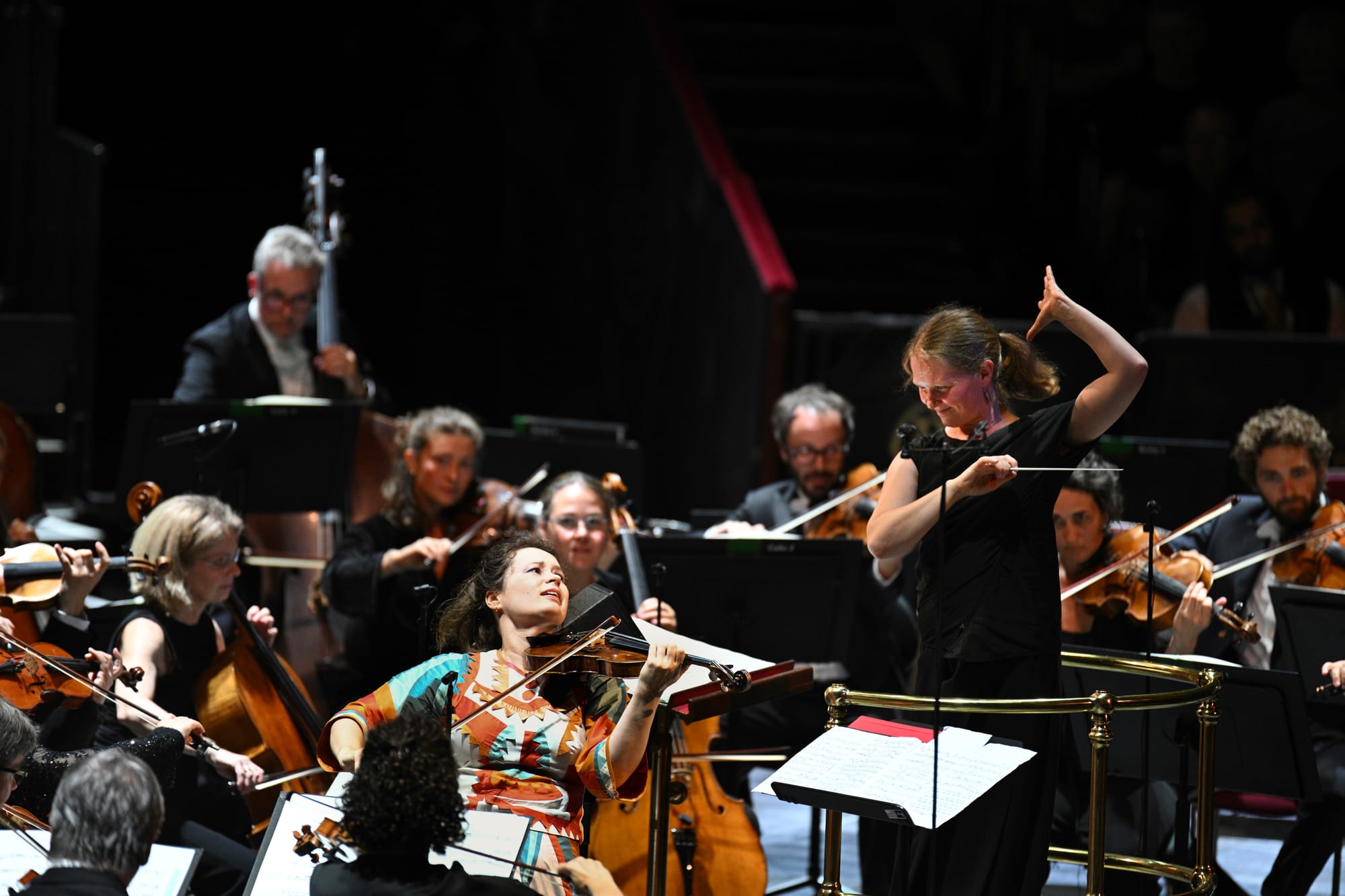
Kopatchinskaja’s bold sound and ability to negotiate quixotic scores is perfect for Stravinsky’s 1931 masterpiece. She also sees the piece’s theatricality – ‘a pizzicato is an event, and a sforzato is something that dancer would take, and jump” as she says in the BBC Radio 3 accompanying interview.
Gesture is indeed a vital part of Stravinsky’s piece, and Kopatchinskaja delighted in each and every one. Sudden changes to slinky dance in the first movement were superbly negotiated – both by Kopatchinskaja and Gražinytė-Tyla, whose rapport with Kopatchinskaja was only equal to her rapport with the Oslo players. Rhythms in Stravinsky need to be spot-on, and every single one was. Most of all, the sense of a pure Stravinsky orchestral sound was there. There were individual triumphs, particularly Principal Trumpet Brynjar Kolbergsrud, but the sense of a composite triumph was palpable. And how Kopatchinskaja embraced the first movement’s final gesture, firing the note out to the RAH roof. Accuracy was definitely second cousin to Affekt there; ‘Aria I’ offered slightly acid-tinged lyricism. Wit was here, too. Pianissimi in ‘Aria II’ were so impressive, the Oslo strings the most perfect cushion to Kopatchinskaja’s ruminations (so off-the-cuff), this itself in perfect contrast to the gritty, grungy finale, marked ‘Capriccio’. Sinewy does not really cover it: lean-toned, Kopatchinskaja was only a whisker away from The Soldier’s Tale. Magnificent.
Here’s the first movement of Stravinsky’s Violin Concerto played by Kopatchinskaja, in her recording with the London Philharmonic Orchestra under Vladimir Jurowski on the French Naïve label, so you can hear that all-important opening chord (so famously wrestled over by Stravinsky ad Samuel Dushkin, the concerto’s first interpreter) which punctuates the concerto throughout:
Kopatchinskaja offered the perfect encore, a ‘cadenza’ for the concerto that Stravinsky didn’t write, but Kopatchinskaja very much did. Imaginative, zany (some swoops that might have been hijacked from the Torvund) it including a second violin part for the Oslo concertmistress, Sarah Christian in a passage that tended at times towards the avian.
So to Prokofiev, a selection of nine movements from Romeo and Juliet (at the relatively recent NYO Collide concert at the Royal Festival Hall, Alpesh Chauhan chose 16 for his second half). Perhaps all was not quite so perfect in the Oslo account in the slow opening to “Montagues and Capulets,’ the post-cacophony strings not quite emerging suspended in the air, the brass not quite stating their octaves together. That said, there was a grim determination to the famous faster section. There was also much that was gossamer in an irrepressible ‘Juliet as a Young Girl’ (complete with a superb clarinet solo). The orchestra is so disciplined, and yet capable of such emotion – a powerful combination. Gražinytė‐Tyla honoured the gentle in Prokofiev’s score as much as the rowdy. Timbral changes as instruments passed themes or notes between each other were a constant source of delight, while the processional that is ‘Masks’ offered an inexorable gait. At the score’s, and the story’s, heart is the ‘Balcony Scene,’ strings not only pianissimo but also luminescent. Balanced by a powerful ‘Death of Tybalt’ (not without Stravinskian echoes in some of the trumpet writing), strings once more utterly together, repeated ‘punches’ relentless, this was a carefully chosen sequence.
Gražinytė‐Tyla’s awareness of the uniqueness not just of Prokofiev’s language (each piece, and each movement within each piece throughout the evening created a unique world of its own) but also his scoring came to the fore in a radiant ‘Friar Lawrence,’ while ‘Dance of the Couples’ positively fizzed along. There was a pronounced femininity to the ‘Dance of the Girls with Lilies’ (Elise Bâtnes now the exceptional solo violin). But it was the final ‘Juliet’s Funeral-Juliet’s Death’ that was astonishing, the sheer emotional fragility of the high violin tremolos of the opening, the sheer weight of emotion later.
A fascinating concert, often full of joy. Torvind has a compositional voice worth exploring; Kopatchinskaja, her usual force of Nature; and Prokofiev’s score in a shining performance.
The disc A Walk into the Future is available at Amazon here; Kopatchinskaja’s Stravinsky/Prokofiev coupling is here.